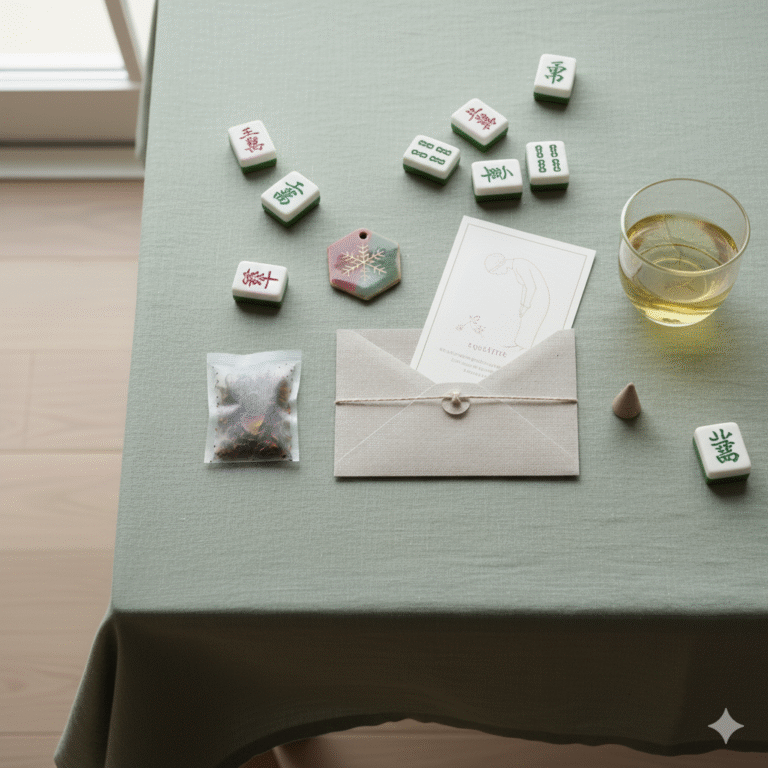
Improving Mahjong Hand Shape: How Strong Players Build Smarter, More Efficient Hands
Improving mahjong hand shape is the foundation of building smarter, more efficient hands that can adapt when the table changes. Improving mahjong hand shape allows players to create multiple improvement paths, avoid dead tiles, and reach completion faster without relying on perfect draws.
1. What Is a Tile Shape (tázi 塔子)?
Improving mahjong hand shape becomes much clearer when comparing flexible and inflexible tile structures side by side. Before diving into specific examples, it helps to understand how different hand shapes behave over time. The table below highlights common patterns that either support strong hand development or quietly limit your options.
| Type | Example | Description |
| Two-sided shape (liǎngmiàn 塔子) |   | The strongest form — can complete from either direction, offering up to eight winning tiles. |
| Closed shape (kǎzhāng 塔子) |  | Needs one middle tile (④) to complete. Moderate flexibility. |
| Edge shape (biānzhāng 塔子) |   | Limited improvement — only completes on one side. |
| Edge shape (biānzhāng 塔子) |   | Limited improvement — only completes on one side. |
| Pair (duìzi 对子) | 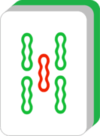 | Used for the pair (eyes) but doesn’t progress your hand directly. |
| Isolated tile (gūzhāng 孤张) | 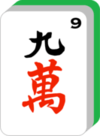 | Offers no connection. Usually discard early. |
Goal: Keep shapes that can grow, and remove those that can’t.
Improving mahjong hand shape requires understanding why certain tile groupings remain flexible while others collapse once a single draw fails. Use the table above as a reference, not a checklist, and focus on how many routes your hand still has available at each stage of play.
2. Ranking Shapes by Improvement Potential
Shapes are arranged from most efficient to least efficient, based on how many possible tiles can improve them.
- 1️⃣ Two-sided shape (liǎngmiàn 塔子)

- 2️⃣ Three-tile sequence (sānlián 搭子)
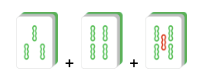
- 3️⃣ Closed wait (kǎzhāng 塔子)

- 4️⃣ Edge wait (biānzhāng 塔子)
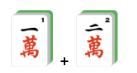
- 5️⃣ Isolated tile (gūzhāng 孤张)

💡 Pro Tip: Middle tiles (4–6) have the best efficiency. Edge tiles (1–2, 8–9) limit your growth options.


3. Efficiency Is Not Fixed — It Evolves
The strength of a shape changes with context and game phase (zhànjú 战局). Even strong two-sided shapes lose value if they’re near the edge (e.g., ①② or ⑧⑨). Closed and edge waits can become valuable if they evolve into better shapes.
- General rule: tile drawing difficulty from the easiest to the most difficult
- In the middle of the game (Part 1 below) and later in the game (Part 2 below)
Part 1:
Part 2:
4. Applying Tile Efficiency in Play
Step 1 – Evaluate Each Shape: Ask yourself how many tiles can improve this shape.
Step 2 – Track Shifts During the Hand: As tiles appear in the discard pool, re-evaluate.
Step 3 – Balance Speed and Safety: When nearing tenpai, maintain flexibility early; focus on completion later.
5. Summary Table
Improving mahjong hand shape is not about memorizing outcomes, but about recognizing patterns that repeat across many hands. The following table illustrates how small structural differences can dramatically affect flexibility and draw efficiency.
| Phase | Priority | Example Decision |
| Early Game | Flexibility | Keep bamboo-3 + bamboo-4 + bamboo-5, drop circle-8.png |
| Mid Game | Balance | Replace edge waits (①②) with central shapes (④⑤⑥) |
| Late Game | Speed & Safety | Choose the tile that finishes fastest or stays safest |
Improving mahjong hand shape requires understanding why certain tile groupings remain flexible while others collapse once a single draw fails. Use the table above as a reference, not a checklist, and focus on how many routes your hand still has available at each stage of play.
Conclusion – Improving Mahjong Hand Shape Takes Repetition
Improving mahjong hand shape is not a skill learned in a single session. It develops through repeated exposure to real hands, careful discard choices, and reviewing why certain routes succeed while others fail. As players gain experience, shape recognition becomes instinctive, allowing decisions to feel calmer and more deliberate. Inside Mahjong Academy, this skill is reinforced through structured drills and practical examples that help players internalize efficient hand building. With repetition, improving mahjong hand shape becomes less about calculation and more about intuition.
Student Exercise
Which of the following shapes is most efficient? Rank them from best to worst.
| Example | Shape Type |
| Two-sided (两面) |
| Closed (坎张) |
| Edge (边张) |
| Isolated (孤张) |